
To determine fake grass quality, inspect the backing strength, the blade density (stitch rate), and the fiber’s finish. High-quality artificial grass should have a matte finish, a heavy, reinforced backing that doesn’t crack, and dense fibers that stand upright, whereas low-quality “fake” grass often looks excessively shiny, feels like hard plastic, and has sparse stitching where you can see the base material.
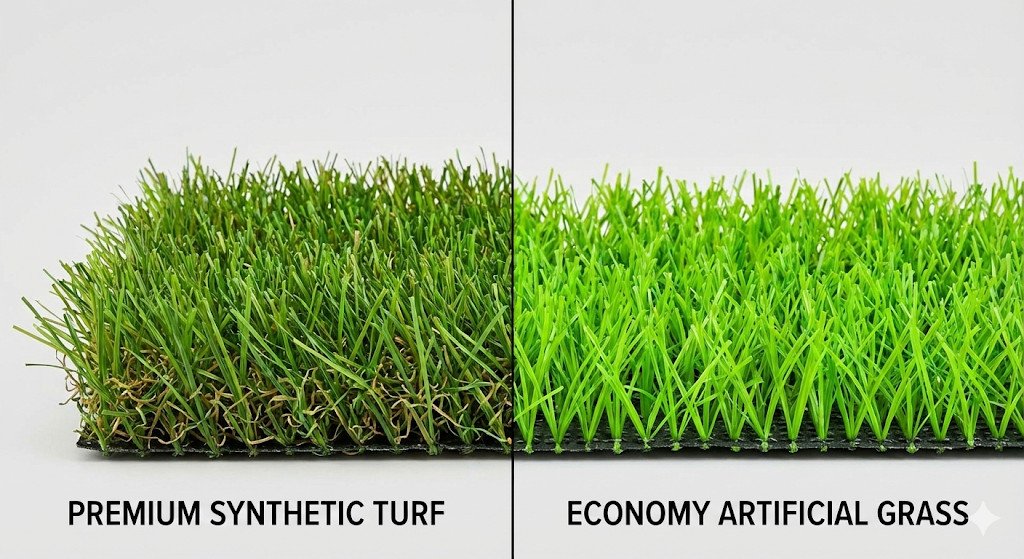
In the bustling markets of Accra, “fake grass” is becoming a popular term. But there is a massive difference between the lush, realistic artificial turf used in luxury homes in Cantonments and the plastic-looking carpets you might see sold on the roadside.
As a buyer, it can be difficult to tell the difference just by looking at a photo or a small sample. You don’t want to spend your hard-earned cedis on a product that flattens out or melts after one dry season.
Whether you are trying to identify if a lawn is real or artificial, or more importantly, trying to determine the quality of the synthetic turf you are about to buy, this guide will show you exactly what to look for.
1. The “Shine” Test: Does It Reflect Light?
One of the easiest ways to spot low-quality “fake” grass is the finish.
- Cheap Grass: Often uses flat, mono-extruded fibers that reflect sunlight like a mirror. This gives the lawn a plastic, unnatural sheen that looks very obvious, especially under the bright Ghanaian sun.
- Quality Grass: Uses advanced blade shapes (like “W” or “C” shapes) and matte-finish polymers. These diffuse light rather than reflecting it, making the grass look deep green and natural rather than shiny and plastic.
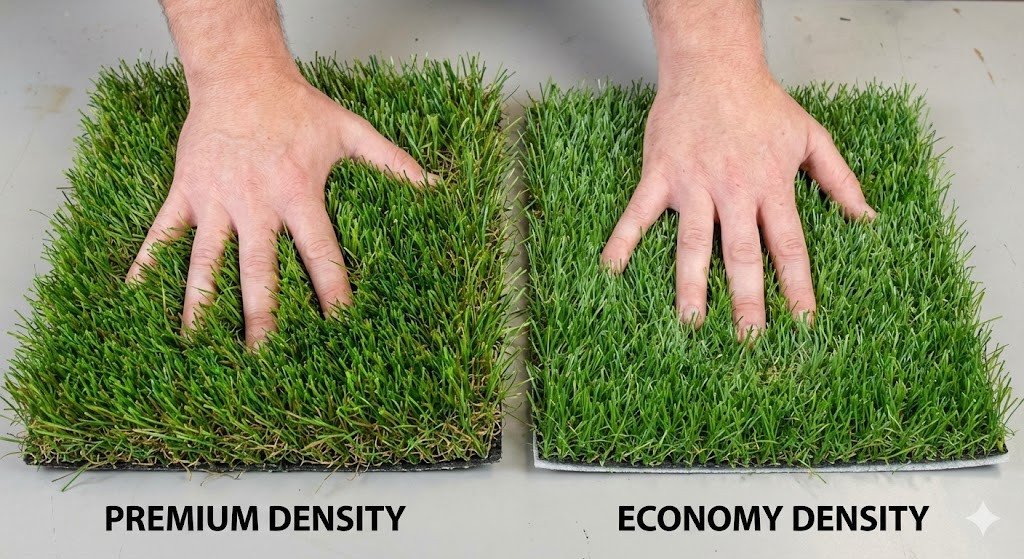
2. Check the Density (Face Weight)
“Face weight” refers to how much yarn is used per square meter.
- How to check: Look at the grass from directly above. Can you see the black backing material through the green blades?
- The Verdict: If you can easily see the backing rows, the density is too low. Sparse grass will flatten quickly under foot traffic. High-quality turf is dense and lush; you should have to part the fibers with your fingers to see the bottom.
3. The Pull Test: Checking the Tuft Bind
This is a critical test for durability.
- The Test: Grip a single blade of grass in the middle and give it a sharp pull.
- The Result: If it pulls out easily, walk away. This means the “tuft bind” (the glue holding the grass to the backing) is weak. In quality manufacturing, the backing is coated with heavy-duty latex or polyurethane that locks the fibers in. If the blades pull out now, your lawn will be bald within a year.
Learn more about how the backing is applied in our guide: How Is Artificial Grass Made?
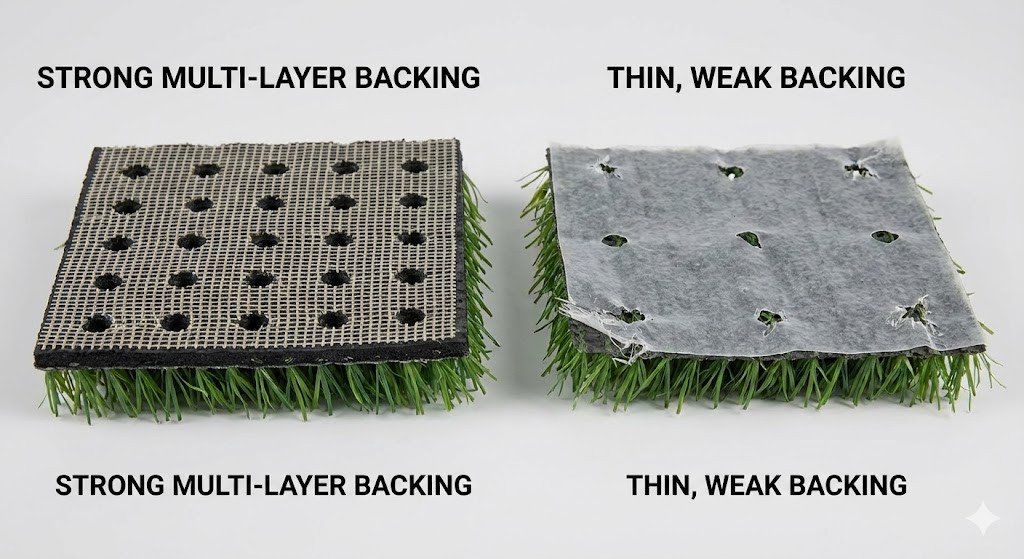
4. Inspect the Backing Material
Flip the sample over. The back of the turf tells you as much as the front.
- Bad Quality: The backing looks like a thin, single layer of fabric. It might peel apart easily or crack when you bend it.
- Good Quality: You should see a primary backing (the grid) and a secondary coating (usually black latex or clear polyurethane). It should feel heavy and substantial.
Note for Ghana: If you have pets, look for Polyurethane (PU) backing, as it doesn’t absorb urine odors like latex does.
5. Color Consistency and “Thatch”
Real grass isn’t perfectly green. It has bits of brown dead grass near the soil.
- The “Fake” Look: A solid, uniform bright green color from top to bottom. This looks like a greengrocer’s display mat.
- The Realistic Look: Quality artificial grass includes a “thatch layer”—curly brown and tan fibers at the root. This adds cushioning and mimics the imperfections of natural grass, making it indistinguishable from the real thing from a distance.
6. Real vs. Artificial: How to Tell Them Apart
Sometimes, our clients ask us: “How can I tell if a neighbor’s lawn is real or artificial?” If the quality is high, it can be hard to tell! Here are the giveaways:
- Uniformity: Artificial grass is perfectly even. No weeds, no dry patches, and no overgrown areas.
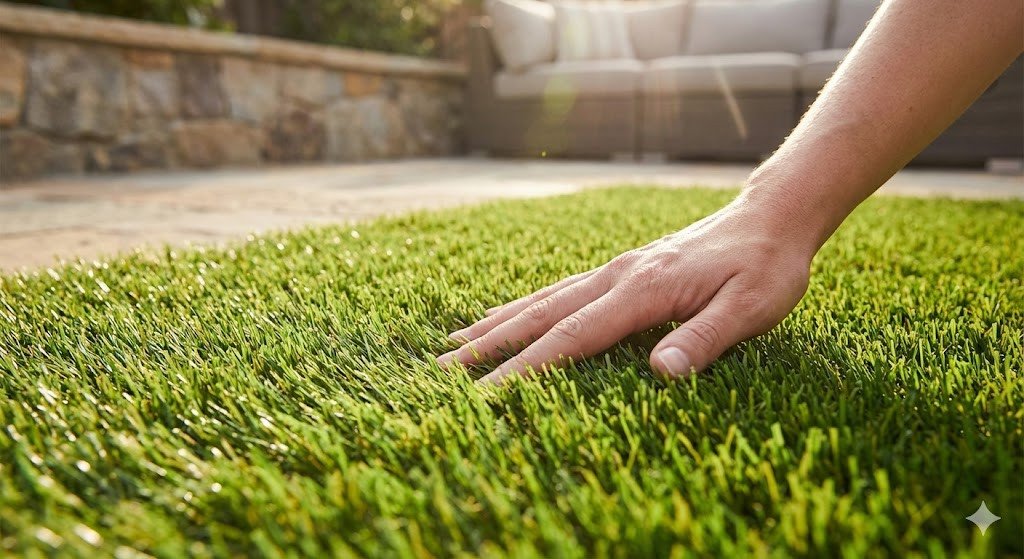
- The Roots: If you press your hand into real grass, you feel cool, damp soil. On artificial grass, you feel the springy rubber infill or the solid backing.
- Temperature: In the afternoon heat, artificial grass will be warmer to the touch than natural grass.
Why Identifying Quality Matters in Ghana
Ghana’s climate is unforgiving to plastics. The UV intensity here will degrade cheap polymers rapidly.
- Fading: Low-quality grass without UV stabilizers will turn grey-white.
- Melting: Cheap turf with flat blades can retain heat, becoming too hot to walk on barefoot.
Worried about longevity? Read: How Long Does Artificial Grass Last in Ghana’s Climate?
Frequently Asked Questions (FAQs)
How do I know if artificial grass is good quality?
Good quality artificial grass feels soft but resilient, has a matte finish (no shine), and includes a brown thatch layer for realism. The backing should not crack when bent, and the fibers should not pull out easily.
Does fake grass look like real grass?
Yes, premium artificial grass is designed to mimic the variation of natural lawns. By using mixed blade shapes, different shades of green, and a brown thatch layer, it can be nearly impossible to tell the difference from a distance.
What is the best pile height for realistic grass?
For a realistic look in a residential garden, aim for a pile height between 30mm and 40mm. Grass shorter than 30mm looks like a sports carpet, while grass longer than 45mm can become heavy and lie flat.
Don’t Get Caught with “Fake” Fake Grass
Now that you know how to determine fake grass quality, you can shop with confidence. Don’t settle for shiny, sparse, plastic-looking mats.
Looking for turf that passes every quality test? Browse our premium, UV-stabilized collection designed specifically for the Ghanaian climate
or locate us at Awudome Roundabout, North Kaneshie (same building with papaye restaurant.) P.O.Box Ao 667, Abossey Okai,Accra -Ghana.
Follow us to stay updated on Artificial Grass News and Products with Affordable Prices:
Instagram: @leterartificial_grassgh
TikTok: @leterartificialgrassgh
Facebook: @leterartificialgrassgh
Twitter: @letergrassgh